Sunday, October 09, 2011

Miata Cylinder Head Assembly and Installation

This weekend I concentrated on getting the engine together. The '99 head is going on the '94 short block. I had to install the valves in the head, and before I could do that I had to clean up the valves and lap them into their respective seats. The valve seats were in really very good shape so it only took a minute or so to lap each valve and get a really nice seal to the valve seat.
The valves cleaned up very nicely. They had some carbon deposits that were pretty stubborn but my trusty brass wire brush on my right angle die grinder finally got to the bottom of it.
This $3 valve lapping tool worked just fine. I used some Permatex valve lapping compound, which is very abrasive. It's super important not to leave any in the engine. It's a little hard to see in the above photo, but what you must achieve is a uniform seat surface without any gaps or thin spots. It should be the same width all the way around. Since this head has such low mileage, the valves took very little lapping.
I had to make a tool to install the valve keepers. A 22mm socket with a window cut in it did the trick. Installing the keepers is an EXTREME exercise in patience. Working through a one-inch hole to get the tiny keepers into a tight spot is frustrating to say the least. I developed my technique - sticking the keeper on the end of a small wood dowel (ok, it was a chopstick) with a gob of grease, and finessing it into position next to the valve stem and inside the retainer, and then do it again with the other keeper without disturbing the first one, then releasing the spring compressor without the whole thing coming apart. I got decently adept at it within the first 5 valves, but then for every 3 that go together very easily in just a few seconds, the fourth one fights you for some reason and takes 30 minutes to get done. In my earlier years I would have broken some things. There are some benefits to growing older and more patient.
This is the coolant fitting on the back of the '94 head. For some reason it got really badly corroded. It was leaking coolant onto the top of the transmission bell housing.
For about 20 bucks I got a new one. I just had to transfer the temperature sensors over.
This is why doing a restoration takes a lot longer than you think it will. This bracket came off the back of the '94 cylinder head. I don't even know what it is for, but I decided to transfer it to the new head, and spent almost an hour wire-brushing the rust and grunge off of it, and painting it with aluminum paint. If this was a REAL restoration I'd have to have it cadmium plated.
Next I fitted the head gasket. Note that it will fit in any orientation but there is only ONE orientation where all the correct coolant and oil passages are clear. I checked it and double-checked it to make sure I got it right.
I bolted the head down, torquing the bolts in a spiral pattern from the middle, to 58 foot-pounds. Then I dropped the lifters in.
Next I installed the cams, the cam bearing caps, and torqued them down to 115 INCH-pounds. Actually, I don't have a torque wrench that reads inch-pounds, so I very carefully used my 3/8" torque wrench set to 10 foot pounds. I also went ahead and installed the water neck with a new o-ring, and installed the cam gears torqued to 40 foot-pounds.
Next I installed the water pump, the outlet pipe, and set the cam cover on top for good looks. It's not bolted down yet. The water pump bolts are torqued to 16 foot-pounds.

Sunday, October 02, 2011

Miata engine refurb stuff

So this weekend I got into re-doing the engine. I got the block cleaned up and painted, the pistons cleaned, the '99 head disassembled and cleaned, and the intake manifold cleaned, painted and reassembled. Note that I'm using the term refurb and not rebuild. I did a compression test before I took everything apart and it had 170 psi across the board, so even though this engine has 155,000 miles on it I'm going to leave it alone for now. If it needs a rebuild later I'll take that opportunity to put higher compression pistons in.
After degreasing and pressure washing I used painter's tape to mask off the deck, oil pump body, and all the exposed machined surfaces. Then I just sprayed the block with red engine enamel. It turned out nice!
Here's the '99 cylinder head with the cams off and the lifters out. My next step was to use my valve spring compressor to remove the valves. See my earlier blog post where I posted a video on how to remove the valves. I used a plastic storage organizer with 16 compartments in it to keep each valve together with its tappet, shim, spring, retainer, and keepers. I want them to go back in the same hole they came out of.
Here's the bottom two-thirds of the intake manifold. This is a great view of the butterflies that make up the VICS system. These butterflies are closed by default but open (or I may have that backwards) at a certain RPM (on '99 and '00 models) to a resonance chamber. The chamber is a dead-end so the path the air takes doesn't actually change when the system engages. This won't work at all on my '94 unless I rig up an RPM switch and a solenoid to engage the actuator. Even without VICS hooked up the '99 head makes more power than the '94 head, so it's a good swap either way.
Here's the '99 intake manifold fully assembled and the '94 throttle body installed. I found the water connections on my idle air control valve are quite corroded so I may devise a way to just bypass it. I painted the manifold with Aluma-Blast from Eastwood and it looks fantastic. The throttle body is too complicated and intricate to spray so I polished it up as well as I could with a soft brass wire wheel on my right-angle die grinder.
The '99 head came with a pretty fresh cam cover so I degreased it and painted it with Aluma-Blast.

Here's a few more photos from this weekend.

Here's one of the solid lifters with the shim attached. I pulled out all 16 lifters and measured the shims. One lifter was missing its shim entirely. I had to make a best-guess as to what size shim would work best in the spot, so I just ordered a couple that were close in size to all the other shims on the intake cam. The ones available from Mazda were mostly not close in size to the shims I have so it may be tricky to get everything in spec. I can't go any farther with the head until I get that shim but it should be here by next weekend.

Monday, September 26, 2011

Removing Miata Engine and Transmission

Getting down to the nitty-gritty on the '94 Miata. This weekend I yanked out the shortblock and transmission together, separated them, and got the engine up on the stand where I can work on it.
With the head off, I had nothing to hook onto with the hoist so I used four old head bolts threaded into the block. It worked like a charm and I was able to pull the whole assembly out by myself without any help. I did discover at the last minute that the hood had to come off, but it's only 4 nuts so I was able to take it off and get it out of the way easily.

Once the assembly was out, it was very easy to separate the block from the transmission. The hard part was then getting the flywheel bolts out. They are installed with quite a bit of tourque and the engine just wants to spin. My impact wrench is not a very good one (need to fix that) so it wouldn't budge the flywheel bolts at all. Absent an impact wrench, the only way to attack it is to somehow lock the flywheel so you can wrench on the bolts without the engine spinning. I did that using the attachment arms from my engine stand, but some steel strapping can be used to the same effect. From there, I used a breaker bar and the handle from my floorjack and was able to get the bolts loose.

With the short block on the stand, I then cleaned the deck of the block and used some aluminized tape (not duct tape but the stuff A/C contractors use to seal duct work) to cover the top of the block so I didn't get water on top of the pistons in the next step.

The engine bay is just about empty. I bagged the connector-ends of the wiring harness and covered the fuse block and the relays as best as I could. The next step there is to prep and paint the subframe and front suspension. Then paint the engine bay.

Just as I suspected there was a bad rear main seal leak. The bellhousing was very oily and messy. The clutch was fine, though.

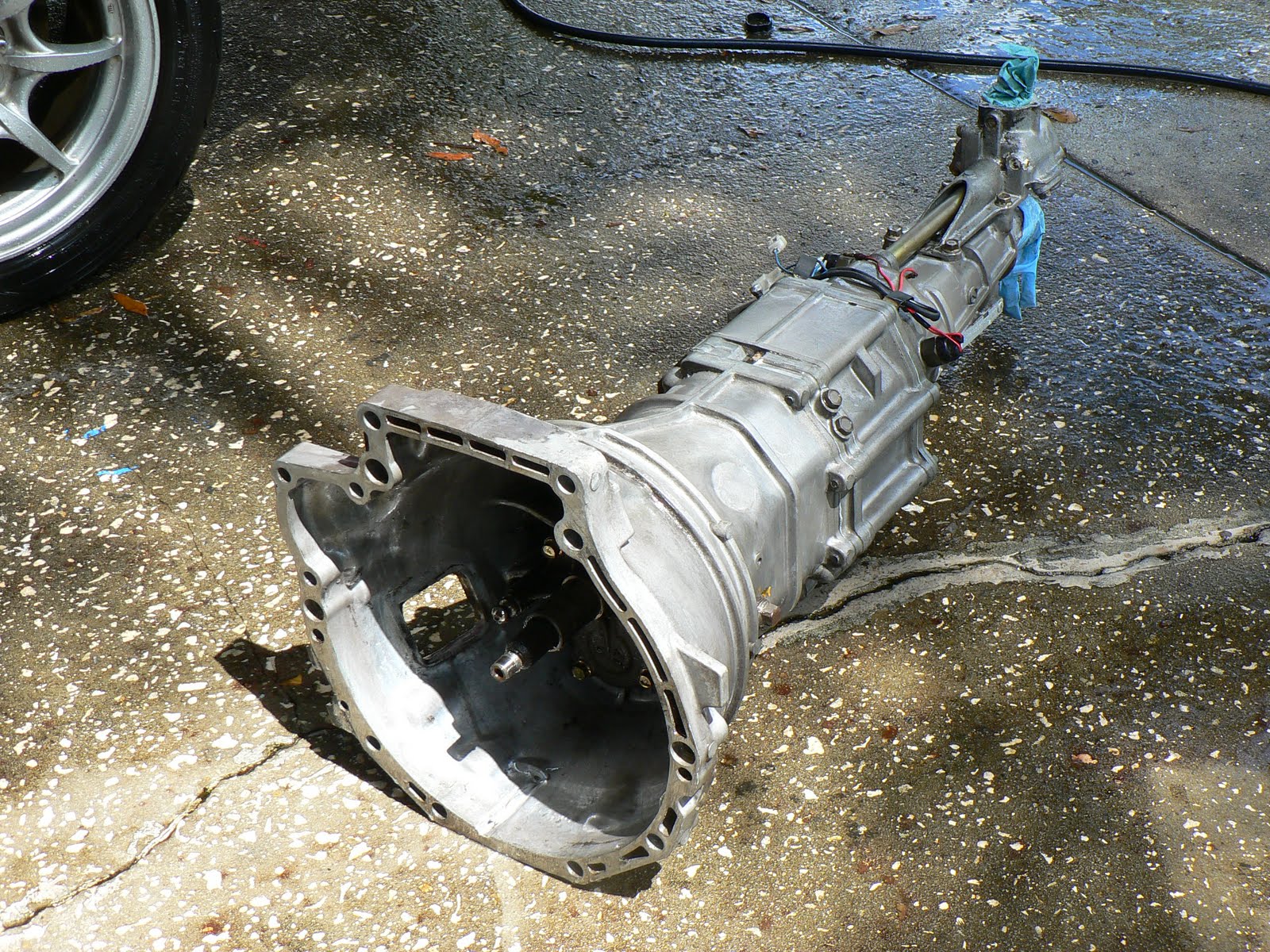
The next step involved a pressure washer and a bunch of Purple Power. I pressure washed the engine bay, front subframe, and everything else I could get to in the front of the car (great opportunity to really clean out the A/C condensor). Then I pressure washed the transmission and the short block, using plenty of degreaser.
Nice clean tranny. I will probably paint it with Eastwood Aluma-blast.

Here's a few more photos in no particular order to help fill in some gaps.

Sunday, September 04, 2011

Depths of the Engine

This weekend I got the head off the engine and I'm ready to continue pulling parts off the block and get it ready to come out as well. I'll pull the block and transmission together, most likely. Overall, the block looks fine. The cylinder wall don't show any scoring or ridges at all, and the cross-hatching is still visible in most places. I'm not planning to tear it down to take measurements because it still had great compression and didn't burn any oil before I started this whole thing.
There's a bit of carbon on the piston tops, but not too much, and the valves and spark plugs look like the engine was running very lean, despite the fact that I thought I had fixed my lean running issue a couple months ago. For sure I was getting less pinging, but I think there may still be a problem. If it's an engine management problem then it will probably still be there when I finish this project because I'm not messing with that.
My good friend Steve offered up a complete cylinder head and intake manifold from a '99 Miata and I'm going to take him up on it. It's a direct bolt-on for this engine and the improvements Mazda made over the '94-'97 head (shown here) were extensive. It's probably good for 7-10 horsepower, which is a lot for these cars. So this head I just yanked out will probably not get reused. Neither will the '96 head I have that I was planning to use. So maybe I can sell both of those and recoup some of my expenses on this project.
Next on the agenda is to get the accessories and the water pump pulled off the front of the short block, and continue stripping the engine compartment so I can paint it. I'm starting to order more parts for the mechanicals. Last night I ordered Mazda Competition motor mounts and a long braided clutch hose from 949 Racing. Also, in the interest of shaving a bit off the budget anywhere I can, I'm going with a clutch and flywheel package from eBay. It's an 11 pound flywheel (stock is close to 20) and an OEM equivalent Exedy clutch and pressure plate, all for under $300. Normally I'm plenty skeptical of cheap car parts, but these have gotten consistently good reviews on the forums so I'm willing to take a bit of a chance since it saves almost $150 over what I had originally planned to get. Also the frame rail reinforcement kit from Flyin' Miata is inbound on the big brown truck from Colorado.

The budget is starting to come into focus as well. Depending on how I cook up the numbers, and counting a few things I've already bought, assuming a budget of about $500 to paint the car myself, and budgeting for a new set of wheels and tires, the total comes to about $3500. Not a bad deal when you consider how cool this car will be and how it will be good for another 10+ years of worry-free driving. That's my theory anyway.

Here's a color I was toying around with. I used Forza on the XBOX to mock up the car with the color and a representative set of wheels. It's between this color and keeping it red. Keeping it red would certainly be less work.


Sunday, August 28, 2011

Pushing Ahead

I'm really trying to maintain some forward progress on the '94 Miata refurb. It's way too easy for these kinds of projects to fade into the background and the next thing you know there's a car in your garage with crap piled on top of it and it hasn't moved in five years. So this weekend I'm getting into the engine compartment. I've removed the radiator and disconnected all the wiring harness connections to the engine. I'm starting to remove accessories and ancillaries in preparation for painting the engine compartment. Today I had planned to remove the cylinder head and intake manifold. I didn't quite get there, though, because the EGR tube fitting on the exhaust header was BEEYOTCH to get off and I didn't have enough steam left in me to get the head off. I also realized that the header is going to have to come loose from the cat so I can get it out of the way, so I decided to stop for today and continue later in the week. I'm really interested to see the condition of the cylinders and the valves, so that will be exciting.
When I pulled the cam cover yesterday, I was pleased to see how clean the top of the engine is. It's got a nice bronze coloration to it, but no sludge or varnish whatsoever. Just goes to show the benefit of running synthetic oil for the last 130,000 miles. It may be a different story inside the combustion chambers, though. This engine was supercharged for 10,000 miles a few years ago and it's been beat to hell on the track and on the street for 18 years now. Recently I had a lot of pinging caused by a dirty AFM so I would not but surprised to find the valves in poor condition. We'll see. Also, I didn't get a picture of it yet, but there is a pretty massive oil leak from the front main seal. This concerns me because I think it's my fault and I think it may be really hard to fix. When I did the timing belt last, about 35,000 miles ago, I replaced that seal but I had a REALLY hard time getting the old seal out. I pried at it with some rather unsophisticated instruments before I really learned the trick to getting stubborn seals out and I think may have scored the side of the recess. If that's the case, I may have an engine that's going to leak for the rest of its service life, and that's a shame because it's a solid bottom end with a lot of life left in it. It sure has made a mess of the front and bottom of my engine, though.
I also started the repairs to the cracks on the dashboard. Using some Permatex PermaPoxy Plastic Weld epoxy (available at your Friendly Local Auto Parts Store (FLAPS)) I welded some small strips of plastic to the underside of the dash, spanning both sides of the three biggest cracks. I also smeared some along some smaller cracks that radiated out from the big ones. There are a couple more I need to get to but I ran out of plastic scraps to weld on. I also ordered a plastic repair kit from Eastwood. My plan is to use this kit to tackle the top side of these cracks because the Eastwood kit can be had in black, clear, or white. Of course my dash is black so my hope is that I can effect a top-side repair that blends in. Already, though, the leading edge of the dash is FAR more sturdy and solid. I have high hopes that this will be a good repair.


Sunday, August 21, 2011

Back on track at Sebring

After a long hiatus, I got back to the track this weekend. I co-drove with my buddy Mark in his '91 VW GTi at a Chin Motorsports track event at Sebring International Raceway. Compared to the absurdly fast cars that have become typical at these track events, our GTi was slow as molasses, but it was still a hoot to drive. Our day ended a bit early when the oil pressure sensor fitting sprung a leak and spewed oil all over the front of the engine and the right front tire, but disaster was averted and we didn't have an engine fire or a wreck. We don't think the engine was damaged so it should be a $5 repair.

Bare floors


So today I didn't feel like doing anything big, so I tackled a few small jobs. I drained the radiator so I could disconnect the heater core and pull the air handler box off the dash, which makes getting the carpet out in one piece a bit easier. So the carpet is all out. It left a bunch of old nasty insulation halfway stuck to the floor so I scraped that up and got the floor really clean. There were a few minor spots of surface rust where the carpet had got a bit wet a few times, so I used the wire brush to clean that up. I also spent some time cleaning parts and polishing up a few metal parts. I spent an hour sanding the raised DOT lettering off of the tail lights and then wet sanding them with 1000 and 2000 grit sandpaper. I saved the final polishing for later when I machine polish the whole car. The carpet is in decent shape. I'll clean it up and reuse it.


Pretty soon I have to start making decisions about how much work I want to do on the engine, what aftermarket parts I want to fit, what color to paint, etc. My objective is to keep the scope of the project achievable while still accomplishing a sufficient level of improvement on the car.


Sunday, August 14, 2011

A little progress

Not a whole lot to report this week. I've just progressed deeper into stripping the car. I put the car on wheel dollies so I can move it around in the garage as needed, which is a huge help. I can get the car out in the middle where I can work on it, and then get it back in place so I can continue to use the garage for my other car. I even spun the car around so the front is facing out. The soft top is now out completely and I plan to just run with the hardtop from here on. It would need a new soft top for sure if I wanted to keep it. I ripped the crap out of it when removing it and the rain rail is shredded. I got 10 years out of it so I guess I can't complain. I have been using a die grinder with a brass wire wheel to clean up the chassis. I'm surprised by the amount of grunge I'm encountering in all the nooks and crannies of this car, and the beginnings of corrosion here and there on fasteners and brackets. I've not found any on the actual chassis of the car, but I'm glad to nip it in the bud here and now. It's just the natural aging of the car, and most cars have rotted away to nothing by the time they are as old as this car is now, but I aim to stop it and preserve this car for some more years to come.
As I'm taking things apart, I'm finding plenty of seals and gaskets that are shot and need to be replaced. So I placed an order at Rosenthal Mazda for the seals around the tail lights, the beltline moldings on the doors, and a couple other odds and ends. The costs add up quickly but it's cheaper than buying a new car!

I spent quite a bit of time cleaning up the trunk of the car. A leaky rain rail deposits quite a bit of dirt in the nether regions of the trunk. I plan to respray the inside of the trunk so it needs to be clean. I removed the rear fascia, the battery, all the hardware inside the trunk, the center brake light, the trunk lid seal, the frankenstein bolts with the chrome hardtop mount trim plates, and the radio antenna mount. I pretty much had to destroy the frankenstein bolts to get them out. The head of the bolt came out but left the stud in place. I had to twist the stud out with vice grips. I'll just install new bolts.

Here's a goodie. A perfect, new HVAC control panel faceplate. The original one has become very yellowed and shabby looking. This piece was just over $20 from Mazda Motorsports and replaces the entire front face of the HVAC control panel. The part number is NA01-61-C04A.

I also got a new windshield molding, so I can take the old one off when I paint. That will make masking a lot easier and allow me to paint right up to the glass and have a much nicer edge. Part number is NA01-50-601A (MLDG UP, FRT WNDW) (LOL @ their part names).


Monday, August 08, 2011

The Reconstruction Has Begun - Spider 2.0

At long last I've returned from the United Kingdom, land of small cars and narrow but wonderfully curvy roads. Upon my return I have immediately undertaken the biggest project I've ever done on my venerable old '94 Miata, "Spider". I've talked about it in previous blog posts but basically this car has been rode hard and put away wet for the last 14 years and a bit neglected on and off during those years when other things took precedence in my life. So in the interest of keeping this car for another 10 years and not being ashamed to drive it (aside from the whole Man Driving a Miata stigma), I've decided to just take it completely apart and put it back together with new parts.

So the plan is to take the interior apart, seats and dash out, with the goal of fixing the cracks in the dash, replacing the heater core (a leak is an eventual certainty), refurb the gauges and switchgear, do something about the seats (the leatherette covers are not holding up well) and yank the soft top out permanently and generally just clean everything up.

Then, the engine is coming out so that I can work on it easier. The goal is to replace the clutch/flywheel with a lightweight flywheel, fix the BIG oil leaks the car has had for the last few years, clean everything up, install a refreshed cylinder head, and while the engine is out, paint and recondition the engine compartment.

Meanwhile, in what is probably going to be the largest part of the job, the exterior is going to get painted. I have some small dents to fill, and I'm going to eliminate the badging on the car. I have not yet decided on a color but I do think I will be changing the color from the factory red. Finally, when it all goes back together, new wheels and tires will complete the package.

Fortunately, the suspension, exhaust, and electrical in the car do not need much if any work. Just a general cleaning up. I've also got a Flyin' Miata frame rail reinforcement brace kit on order, to restore some of the stiffness the car has lost over the years.

As you can see from the photos, the dis-assembly of the car is well under way. The seats and dash are out and almost all of the exterior trim is off.